

Buying AI licences is easy. Deciding what you are prepared to let AI do in your company’s name is the difficult part.
A CEO should not be approving every prompt. But “my IT team is handling AI” is not a strategy either.
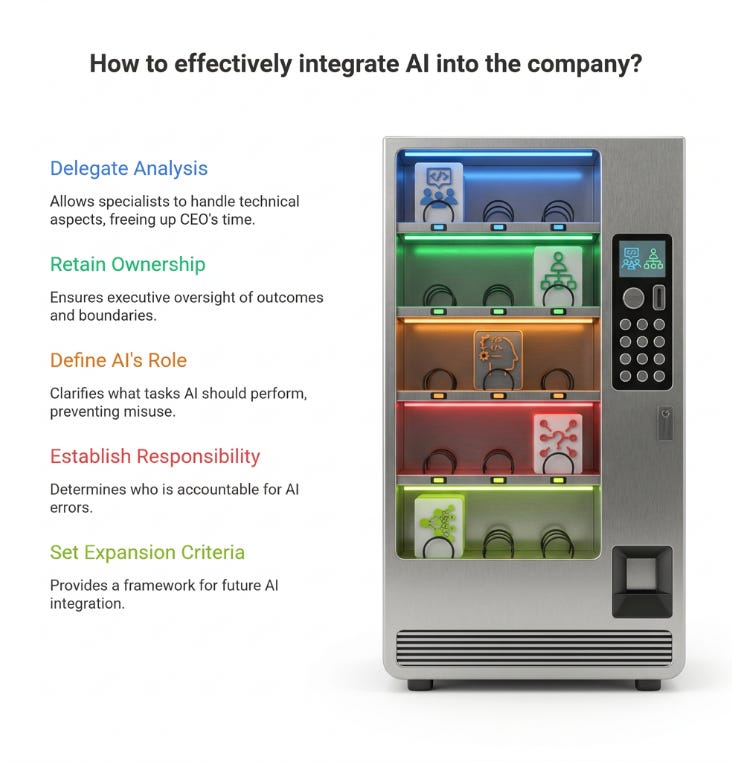
For CEOs, I would put five decisions ahead of software selection. Delegate the analysis and implementation to specialists; retain executive ownership of the outcomes and boundaries.
Consider a hypothetical finance team. It wants AI to compare supplier invoices with purchase orders and prepare an exception report. Useful, perhaps. But before connecting anything, the leadership team needs to answer five questions.
1. What business result are we actually buying?
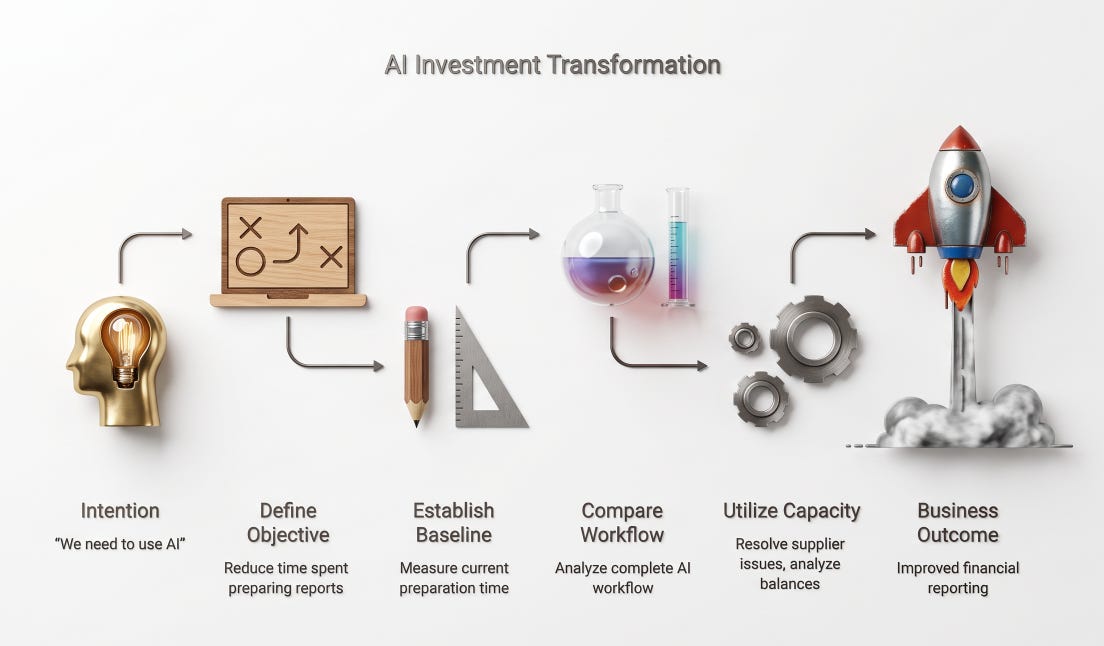
“We need to use AI” is an intention, not an investment case.
For our finance team, the objective might be to reduce time spent preparing a reliable exception report. That is more useful than counting how many employees have opened an AI application.
Establish the starting point: preparation time, reviewer effort, errors missed and corrections required. Then compare the complete workflow, not just the few seconds it takes to generate a response.
If AI saves an hour of preparation but adds two hours of checking, the demonstration may look impressive while the process gets worse.
I would also ask what happens to the capacity released. Does someone resolve supplier issues sooner? Analyse an overdue balance? Improve a forecast? Time saved becomes more valuable when you decide how to use it.
The CEO’s decision is which business outcome deserves investment. The technical team should help achieve it, not invent the business justification afterwards.
2. Where does AI’s authority end?
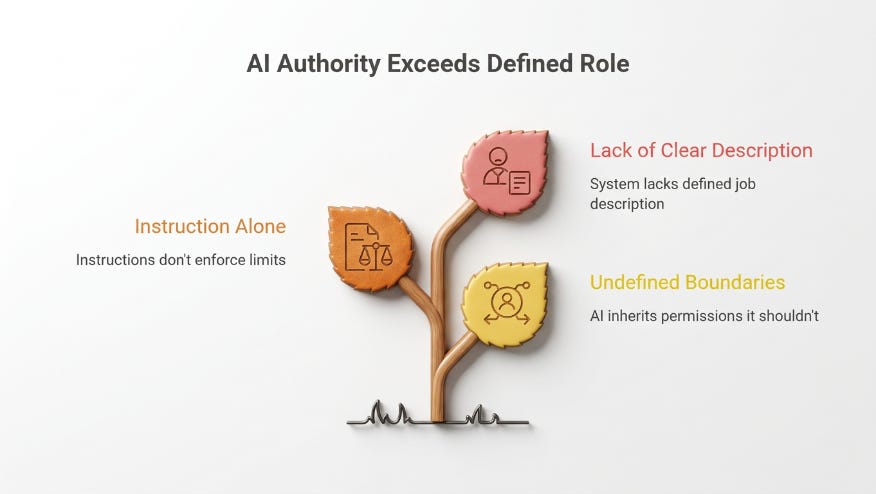
Preparing an exception report and authorising a payment are different jobs. They should not inherit the same permissions just because one system could potentially handle both.
For the hypothetical pilot, I would define the boundary explicitly: AI may compare approved records, flag discrepancies and draft a report. It may not change supplier bank details, release payments or contact suppliers without the required approval.
An instruction alone is not a control. Have the team enforce those limits through access permissions and approval steps, then test that the system cannot cross them. This is what I mean by a Digital Employee: an AI-enabled system assigned a defined business role, with limited authority, supervision and an escalation route. It is an operating concept, not a claim that software becomes a legal employee.
Good delegation requires a clear job description. Giving a system a human name is the easy part.
3. What information should it be allowed to see?
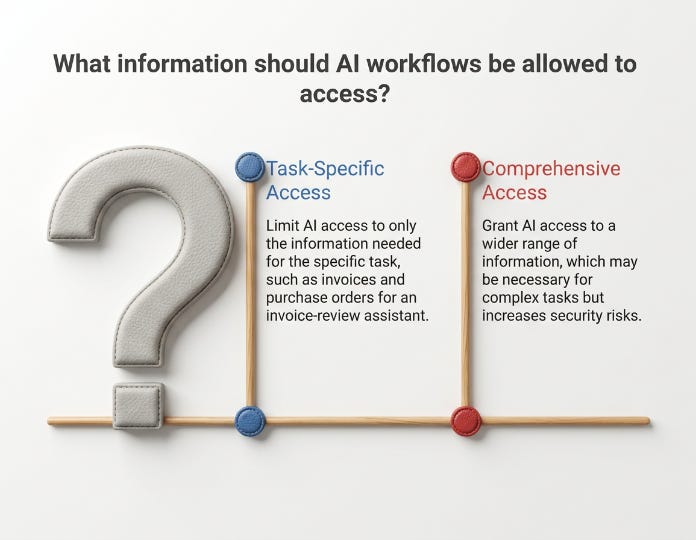
The fact that information exists inside your organisation does not mean every AI workflow needs access to it.
Start with the task. Our invoice-review assistant may need selected invoices and matching purchase orders. It does not automatically need payroll records, board papers or the entire finance mailbox.
Ask the implementation team to explain which information enters the system, which provider processes it, who can retrieve the outputs, and what is retained. Verify those answers against the actual configuration and contractual terms, rather than assuming every product has the same settings.
For a business operating across several markets, map the relevant entities and information flows before expanding access. Have your legal, security and data teams check the applicable obligations; a location label on a product is not enough to settle the question.
Your leadership decision is the boundary. Specialists should translate it into controls that can be inspected and tested.
4. Who is responsible when the output is wrong?
“A human will check it” sounds reassuring until nobody can name that human or explain what checking involves.
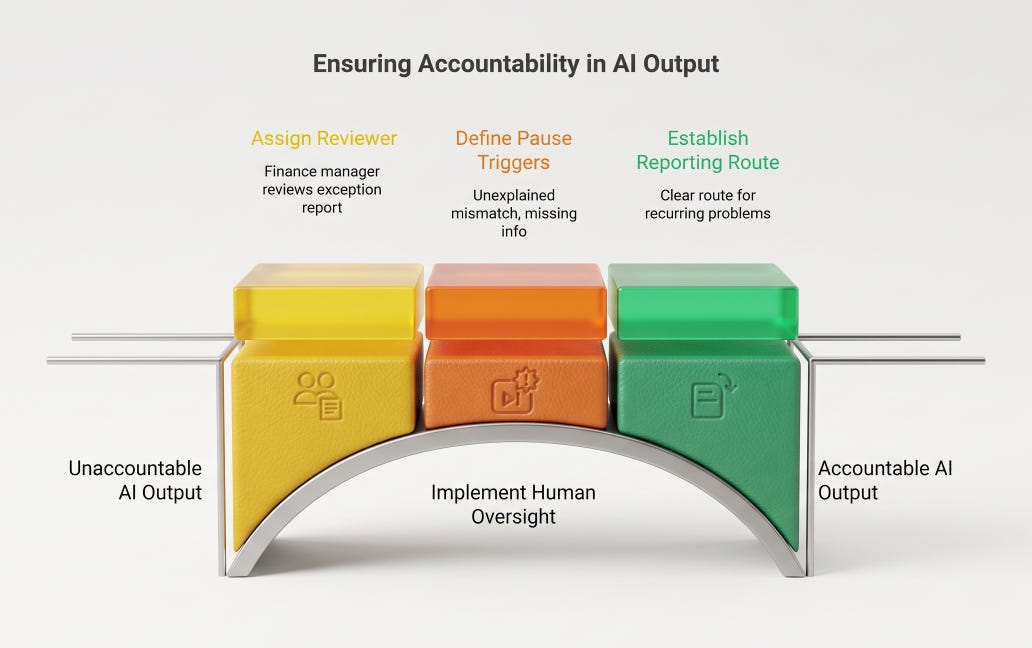
In our example, assign a finance manager to review the exception report against the source records. Give that person time, access to the evidence, authority to reject the output and a clear route for reporting a recurring problem.
A reviewer who can only click Approve is not meaningful oversight.
Define what triggers an immediate pause: an unexplained mismatch, missing source information, an attempted action outside the permitted role, or a failure the team cannot explain. Decide who takes over and how work continues without the AI system.
The NIST Generative AI Profile is a useful supporting reference for your team’s risk review. My practical test is simpler: can the people responsible explain what they check, what they can stop, and what happens next?
5. What evidence earns permission to expand?
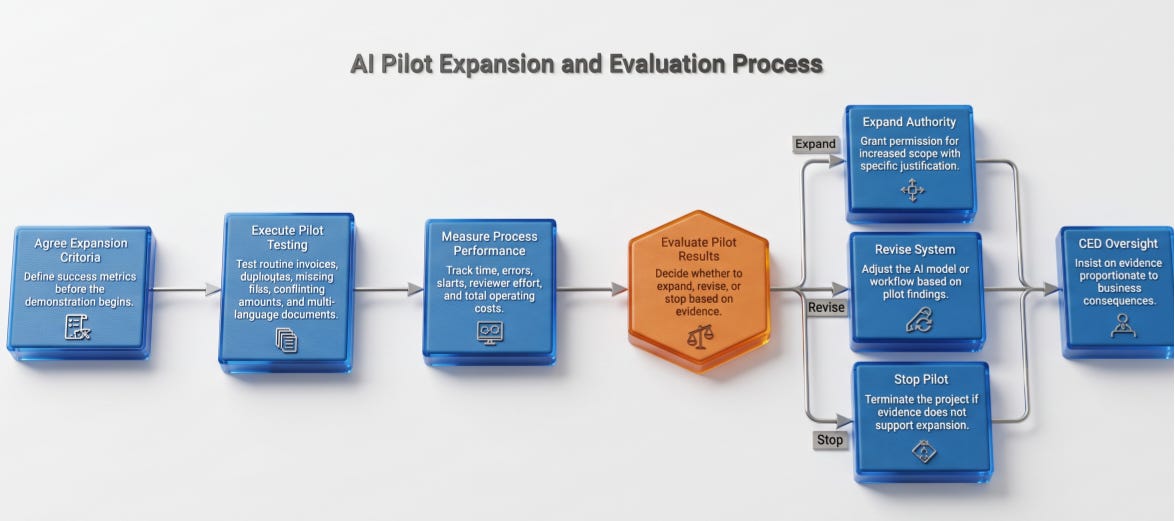
Agree the expansion criteria before the demonstration. Otherwise, enthusiasm can become the decision-making process.
For the finance pilot, test routine invoices alongside duplicates, missing purchase orders, conflicting amounts and documents the system struggles to interpret. Where the intended workflow includes Arabic and English documents, test both. Those are proposed test cases, not claims about a completed deployment.
Measure the whole process: time to a checked report, important errors missed, unnecessary alerts, reviewer effort and total operating cost. Record failures as carefully as successful cases.
Then decide whether to expand, revise or stop. A useful pilot should be allowed to produce any of those answers.
Expansion should also have boundaries. Permission to review more invoices does not automatically mean permission to approve payments. Each increase in authority needs its own justification.
The CEO’s role is to insist on evidence proportionate to the business consequences, not to become the person who tests every document.
The leadership skill is delegation
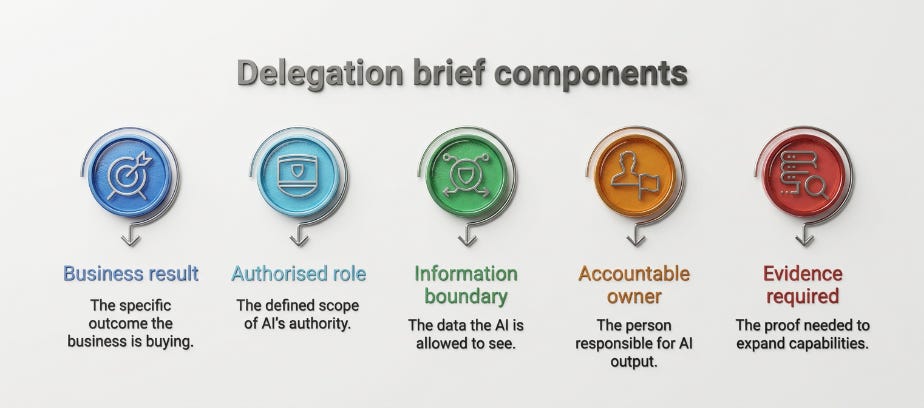
Before your next AI investment discussion, ask for a one-page delegation brief: the business result, the authorised role, the information boundary, the accountable owner and the evidence required to expand.
If the team cannot explain those clearly, I would resolve the ambiguity before buying more capability.
This is also the standard I would apply to executive AI training. Leaders should leave able to challenge a proposal and define a responsible pilot, not simply recognise more product names. In an AI strategy keynote, the interesting discussion begins when the audience can apply these questions to its own business.
Your next employee may not be human. But your responsibility as a leader still will be.
Which of these five decisions is the least clear in your organisation today?

Prof. Christian Farioli is an international AI keynote speaker, digital strategist and executive coach. For an AI keynote or leadership workshop, explore speaking and executive programmes.
